
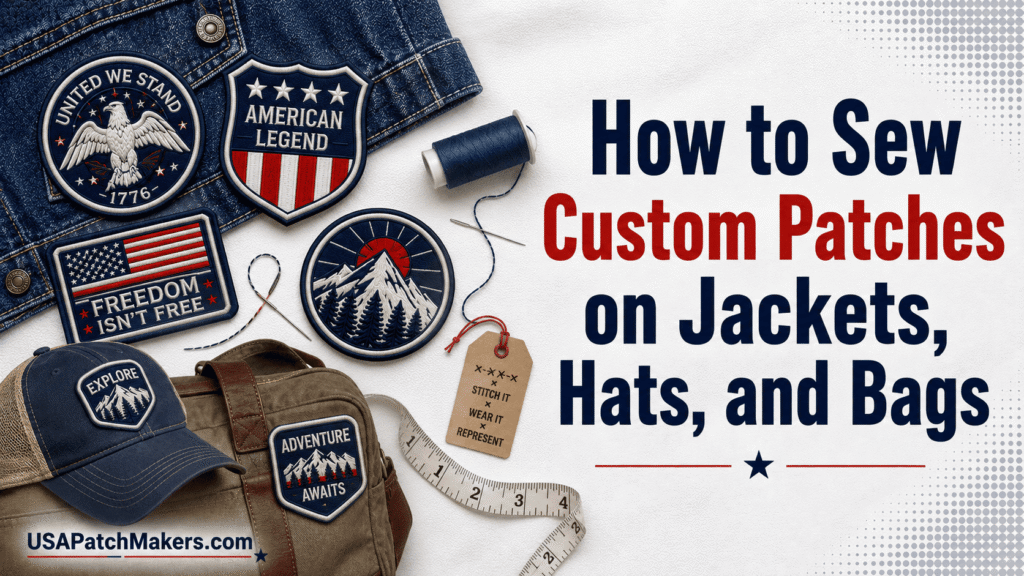
Sew-on custom patches are the best choice when you need durability, longevity, and peace of mind. But people usually search for how to sew custom patches on jackets, hats nd jeans. This is why we composed this guide to let you know the right steps: how to sew on custom patches on uniforms, shirts, bags, or any clothing.
Why Sew Custom Patches Instead of Iron-On?
Let’s uncover the reason why patch makers prefer sew-on custom patches before answering how to sew custom patches. As you know iron on patches are not recommended when you need long-lasting results; they start peeling off after a few washes and wear. But sew-on custom patches are known for dealing with tough weather and moisture, and staying on permanently. Especially if you are applying custom patches on hats, jackets, or jeans, you should always use sew on custom patches method.
What You’ll Need to Sew a Patch
People need to know what materials they need before jumping right into a guide for how to sew custom patches on jackets, jeans, or hats:
- Sew on custom patches (pre-cut with clean, finished edges)
- Needle and matching or contrasting thread
- Sewing pins or fabric clips
- Scissors
- A sewing machine (optional, but faster for multiple patches)
- A thimble, if hand-sewing through thick fabric
How to Sew Custom Patches by Hand
If the fabric is thick, or you are working on a single project, you can use hand-sewing to make custom patches on clothes. Usually, people search for how to sew custom patches by hand because they are working on jacket sleeves or bag straps. Follow these steps:
- Position the patch. Place it exactly where you want it and pin or clip it in place to prevent shifting.
- Thread your needle using a double strand, which gives your patch extra strength, knotting the end.
- Start from the back. Push the needle up through the fabric at the patch’s edge, hiding the knot underneath.
- Use a whip stitch or backstitch. Stitch closely, about 1/6 inch apart, for a secure hold around the patch perimeter.
- Tie off securely on the back once you’ve gone all the way around, and trim excess thread.
How to Sew Custom Patches on a Machine
For bulk production sewing machine plays an important part; it speeds up the whole process.
- Pin the patch in place on flat, accessible fabric.
- Set your machine to a straight or zigzag stitch. Use a zigzag stitch because it gives more flexibility and covers the whole edges of the patches.
- Sew slowly around the perimeter, keeping the needle close to the patch’s edge without going off it.
- Reinforce corners and curves by slowing down and pivoting with the needle down.
- Backstitch at the start and end to lock the stitching in place.
Sewing Patches on Different Materials
Here are a few tips you need to know while reading our guide for how to sew custom patches on different clothes such as:
Jackets
You can easily sew on denim and canvas because these fabrics are thick enough to handle stitches without puckering. Use hand sewing method for leather jackets; with a sharp needle, you get fine results.
Hats
It gets difficult to sew curved surfaces like caps using machine sewing. But you can try hand sewing to keep stitches tight and evenly spaced. First work in short sections rather than sewing the whole curve at once.
Bags
Bags come in canvas and nylon fabrics, so it’s easy to sew custom patches on them compared to delicate fabrics. For flat bag surfaces, you can use machine sewing, but always prefer hand sewing if you are working on thick, sharp edges.
Sewing Method Comparison
So you have been scrolling for how to sew custom patches for hours and need a short answer on what to select? Here is a brief comparison between different methods of sewing to whats best for durability:
| Method | Best For | Durability |
| Hand sewing | Hats, curved surfaces, leather | High |
| Machine sewing | Jackets, flat bags, bulk projects | High |
| Whip stitch | Reinforcing existing patches | Moderate to high |
| Backstitch | Maximum hold on flat fabric | Highest |
Prevent Messing Up Your Patches During Sewing
After you understand different methods of how to sew custom patches on clothes like jackets, hats, and bags, time to know what not to do while sewing:
- Never sew an iron-on patch with adhesive backing, as they gum up the needles and weakens stitches.
- Using thread that doesn’t match or complement the patch border
- Skipping pins or clips, which lets the patch shift mid-stitch
- Rushing corners and curves, leading to loose or uneven stitching
- For thick fabric going with machine sewing without picking the right needle or machine setup.
Final Thoughts
You must understand both major ways of how to sew custom patches on jackets, jeans, hats, or bags: machine sewing and hand sewing. For thick fabrics, go with hand sewing as it gives more control over stitches. However, for normal fabrics like cotton, you can use the machine sewing method. To stand out in the crowd, choose our custom patches like embroidered, chenille, and woven.
Frequently Asked Questions
Is sewing better than iron-on for custom patches?
Yes, sewing patches onto clothes is more safe, and they last longer. Iron-on patches are only recommended for temporary application.
Can I sew a patch onto a leather jacket?
Yes, you can use hand sewing method and grab a sharp and heavy duty needle for precise stitching on leather patches.
Do custom sew-on patches come with any backing at all?
Most sew-on patches have a neutral fabric backing with a stitched groove along the edge, which makes hand or machine sewing easier and more precise.